When Their Playlist Becomes Your Personality: The Strange Way Friendship Rewires Your Music Taste
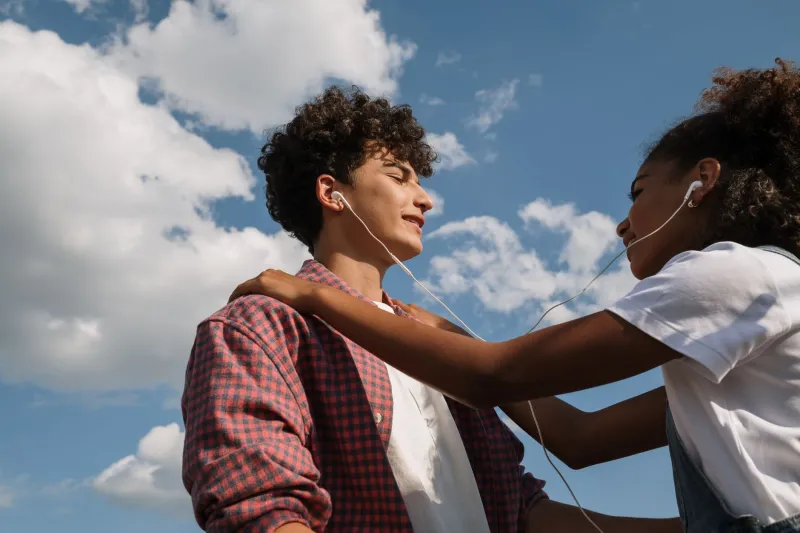
You didn't ask to become a hyperpop person. You were perfectly happy with your indie folk and your carefully aged Spotify Wrapped. Then your best friend started sending voice memos at 11 p.m. with clips of songs you'd never heard, dragging you into a group listening session on a Tuesday, and suddenly — somehow — you're defending a Charli XCX deep cut to people who didn't even know you'd made the switch.
This is the deluxe edition of friendship. Not the standard version where you just vibe together. The expanded, bonus-track version where you start absorbing each other's entire sonic identity.
The Shared Queue Is a Shared Identity
It starts innocently enough. Someone adds a song to the group playlist. Then another. Then the whole thing becomes a rotating diary of whatever your friend group is collectively going through — breakups, road trips, that weird month where everyone was really into ambient music for reasons nobody fully explained.
Shared streaming accounts accelerate this. When you're splitting a Spotify Family or Apple Music plan, the algorithm doesn't just learn you — it learns the blended version of all of you. Your Discover Weekly starts sounding like a compromise between your taste and your roommate's. The recommendation engine doesn't know where one person ends and another begins, and honestly? Neither do you after a while.
Psychologists have a term for this kind of influence: social identity theory. The basic idea is that we define ourselves partly through the groups we belong to, and we unconsciously adopt the preferences of those groups to signal membership. Music is one of the fastest, most visible ways to do that. Throwing on someone else's favorite artist at a pregame isn't just being a good guest — it's a small act of belonging.
The Performance of Enjoying Something You Don't Fully Get
Here's the part nobody really admits: a lot of us have pretended to like a song longer than we should have, just to stay in sync with someone we care about.
Maybe it was nodding along to a 10-minute ambient track your college roommate was obsessed with. Maybe it was adding a rapper you'd never heard of to your liked songs because your friend's whole personality was built around that artist, and calling them mid-tier felt like a betrayal. The music becomes a stand-in for the relationship itself. To reject the song is to reject, at least a little, the person who loves it.
This isn't fake or shallow — it's actually a pretty normal part of how taste develops. You fake it until you make it, and somewhere in the faking, your brain starts to actually find the thing interesting. Repeated exposure is real. Psychologists call it the mere exposure effect: the more you hear something, the more familiar it feels, and familiarity has a sneaky way of turning into affection. Your friend didn't just recommend an album — they rewired your neural pathways, one passive listen at a time.
When the Vibes Don't Match and It Gets Weird
But what happens when the musical merge just... doesn't take?
Taste incompatibility in friendships is genuinely underexplored territory. We talk about it as a funny quirk — "oh, she's the one who likes country, we don't talk about it" — but there are real moments of friction when someone's sonic identity is central to who they are, and you just cannot get on board.
The group chat goes quiet when someone shares a song and nobody responds. The aux cord becomes a negotiation. The collaborative playlist starts to look like a map of a friendship's fault lines — all the songs one person added that nobody else ever played, sitting there like unanswered texts.
For some people, music taste is deeply tied to self-concept. If you dismiss what they're listening to, you're not just skipping a track — you're skipping a piece of how they see themselves. That's a lot of pressure to put on a Spotify recommendation, but here we are.
The Algorithm Knows You're Changing
What makes this whole thing especially interesting in 2024 is that the platforms are watching it happen in real time.
Spotify's algorithm is constantly recalibrating based on what you actually listen to versus what you skip. If you've been playing your friend's playlist on repeat for two months, the system is going to start treating that as a genuine reflection of your taste — not a social accommodation. Your end-of-year Wrapped will look different. Your recommendations will drift. In a very literal, data-driven sense, the friendship has changed who you are as a listener.
Some people find this unsettling. Others find it kind of beautiful. There's something poetic about the idea that close relationships leave an actual trace in your recommendation history — a sonic record of who mattered to you and when.
The Boomerang Effect: Taste You Thought You Borrowed Becomes Taste You Own
Here's the twist that doesn't get talked about enough: a lot of the music you now think of as yours probably started as someone else's.
That artist you've been riding for three years? Your college friend put you on. That genre you'd die on a hill for? Your ex introduced you to it during a road trip, and you kept the music even after everything else ended. Human taste is almost never developed in isolation. It's collaborative, cumulative, and heavily influenced by whoever happened to be in the room — or the group chat — at the right moment.
Which means the next time you're sitting with a new sound that doesn't quite click yet, and you're only listening because someone you love won't stop talking about it, maybe give it a few more plays. Not for them. For the version of you that might genuinely love it in six months and have no memory of how it started.
The deluxe edition of friendship comes with bonus tracks you didn't choose. Some of them are going to become your favorites.